Fix Muddy Farm Lanes: Dirt Work Tips for TN Farmers
Farm lane repair and fixing field entrances requires addressing drainage issues and soil stability through professional dirt work. By grading the surface to redirect runoff and reinforcing soft areas with appropriate base materials, you can prevent washouts and ensure the lane supports heavy agricultural equipment year-round.
Why does my farm lane keep washing out?
If you have spent any amount of time farming in Henry or Weakley counties, you know that our West Tennessee dirt has a personality of its own. When the rain starts coming down hard in the spring, those trusted paths between your fields can turn into riverbeds faster than you can get the tractor back to the shed. The main reason a farm lane washes out is almost always water management—or a lack thereof. When water doesn’t have a clear, planned path to leave the roadway, it creates its own path, taking your expensive gravel and topsoil along with it.
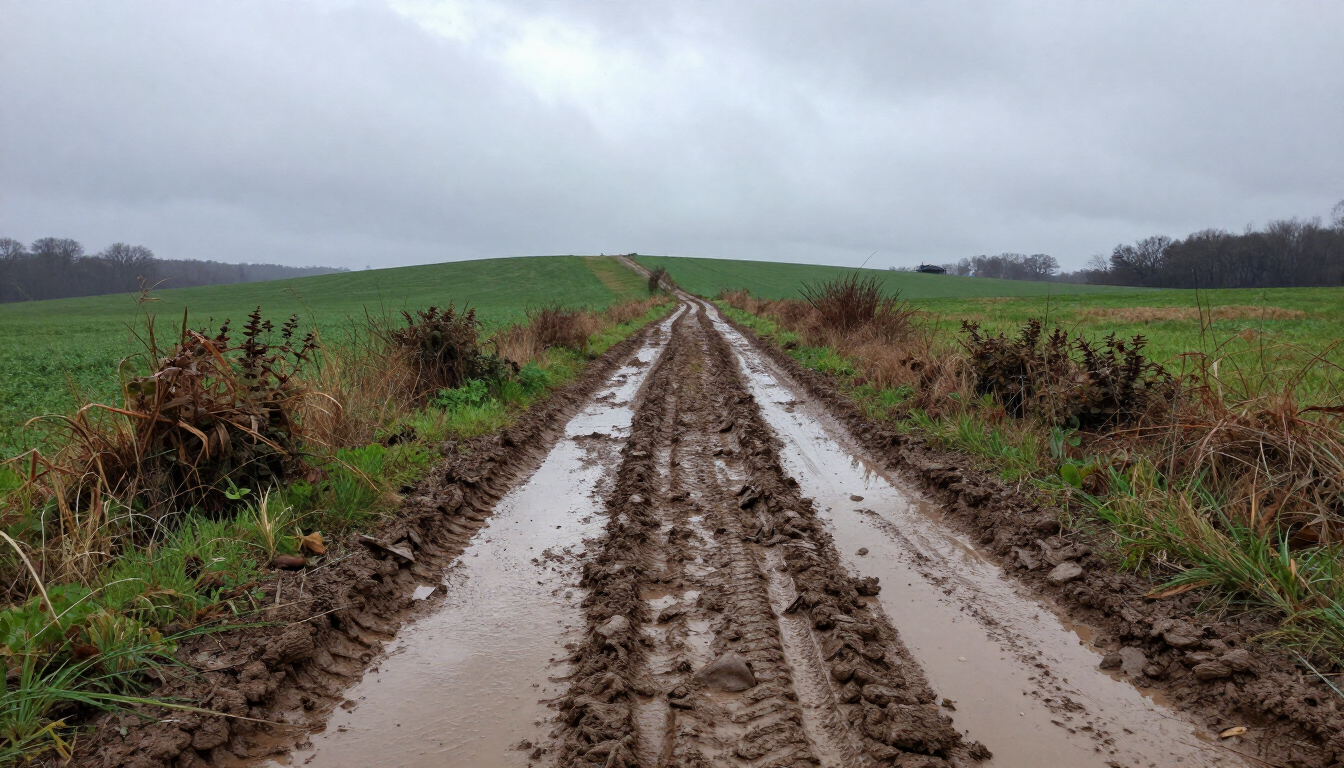
Over time, even the best-laid trails can succumb to the sheer weight of modern machinery. Today’s planters, combines, and grain carts are significantly heavier than the equipment used twenty or thirty years ago. This weight creates deep ruts that act like tiny canals, trapping water exactly where you don’t want it. Instead of shedding off to the side, the water sits in those ruts, soaking into the subgrade and turning the ground beneath the surface into a soft, spongy mess. This is often why a lane might look dry on top but collapses the moment you drive a heavy load over it.
Another major factor is the natural composition of our soil. In our neck of the woods, we deal with a lot of silty loam. While it is great for growing crops, it isn't always the sturdiest foundation for a high-traffic road. Without proper Site Preparation & Finish Work , the soil simply doesn't have the structural integrity to stay put under pressure. When we look at a washout, we aren't just looking at the hole in the ground; we are looking at where that water started and why it decided to stop there.
Common causes of soft field entrances
Field entrances are the most abused parts of any working acreage. They are the transition points where heavy equipment moves from a hard-packed county road or a main lane onto softer field soil. Because these areas see constant starting, stopping, and turning, the shear force applied to the ground is immense. When an entrance stays too soft, it’s usually because the transition wasn't built to handle the load-bearing requirements of a modern farm operation.
Common reasons for soft entrances include:
- Poor Subgrade Compaction : The dirt underneath the gravel wasn't packed down tight enough before the top layers were added.
- Inadequate Base Material : Using the wrong type of rock or not enough of it means the weight of the equipment isn't distributed evenly.
- Standing Water : Entrances are often lower than the surrounding terrain, causing them to collect runoff from both the field and the road.
- Organic Matter Buildup : Over years, leaves, stalks, and mud build up, creating a layer of "muck" that holds moisture like a sponge.
- Lack of Maintenance : Small ruts that aren't filled immediately become large bogs after just one or two heavy rain cycles.
When we provide Excavation & Dirt Work for local farmers, we often find that the quickest fix isn't just dumping more rock on top. In fact, adding more weight to a soft spot can sometimes make the problem worse by pushing the mud up around the new gravel. True farm lane repair involves stripping away that saturated organic material and getting down to a solid base. We use our 25+ years of combined experience to evaluate whether the ground needs to be re-contoured to push water away or if the entrance needs a complete rebuild from the bottom up.
What should you note before calling an excavator?
Before you pick up the phone to call in a professional, it helps to be an observer of your land during a storm. We always tell our clients in the Service Area that the best time to see what’s wrong is when it’s raining. You don't have to get soaked, but take a look at where the bubbles are forming and which way the